
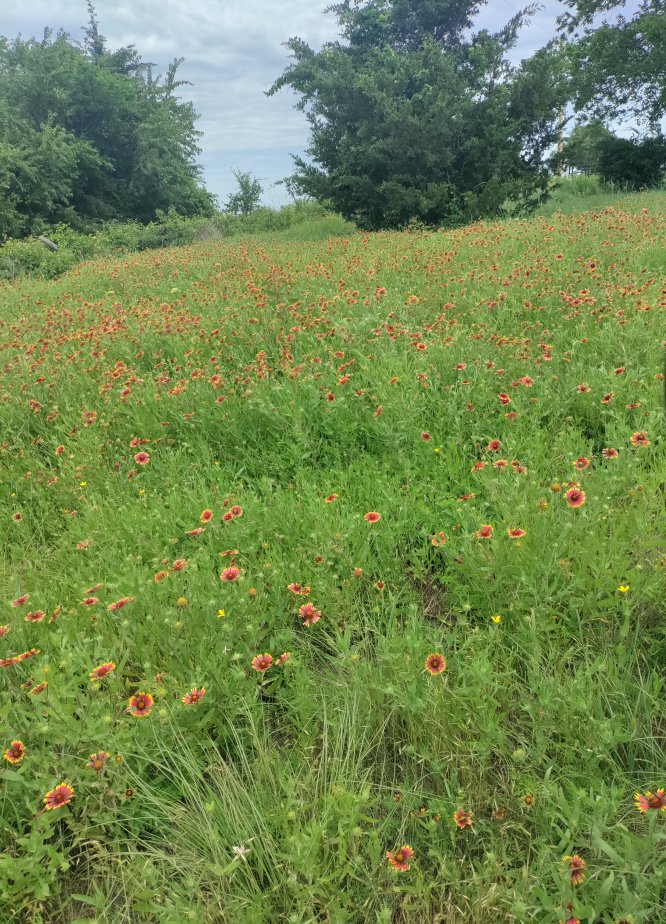
 Texas weather is finicky. Some years we have a good nectar flow… and some years – we don’t. By early-May we have a good idea of how the year is going to look.
Laura and I have noticed MANY locations this year that the hives are dry as a bone inside – with absolutely no nectar being stored. While you may see flowers in nearby fields – that does NOT necessarily mean they have a viable food source. While all flowers will provide pollen (protein source to feed young larvae) – not all flowers will have nectar – which is the bees’ carbohydrate source – that is used for energy to fly, as well as to create royal jelly to feed to the queen, and to the newly hatched eggs/larvae. And excess nectar is dehydrated to be honey – and stored for times when there’s no natural forage.
What does this mean? It can be the product of several things…
- Simply not enough nectar-producing flowers in their forage range
- Bad timing for rain (it can take 3-4 days for nectar-producing plants to recover from a rain and thicken up their nectar secretions)
- Heat – once we hit about 95 Deg F (35 C) – the nectar dries up in the plants
- Viable flower fields get mowed too early.
Yes – we have encountered several fields that were BEAUTIFUL – with bees all over the flowers – that then get mowed while the good forage-blooms are still active. The food for the pollinators just got cut down. In one location – the field was mowed WHILE we were there working with the bees. It was heartbreaking to see this – and then having to answer the question later in the year of “When will we get some honey?” Well – in years like this – we’re starting to feed the bees syrup to make up for their lack of natural forage. When we’re feeding bees – there’s no honey to be taken.
What can you do? Support pollinators by planting pollinator-feeding plants. Trees often will have more nectar produced per tree, than an acre of wildflowers. PLANT TREES – IN ADDITION TO WILDFLOWER SEEDS!
Some trees that ALL the pollinators love are: Chinese Tallow (this is Texas’ #1 honey-producing plant – on the Texas coast and in deep East Texas) , Soapberry, Vitex, Mexican Buckeye, Privet, Holly Bushes/trees, Ligustrum. Areas where we ARE seeing nectar stores in the hives – tend to have bee-balm in bloom nearby (also known as horsemint or Monarda)
In the meantime – Laura and I are starting to mix a sugar/water blend to feed the bees, since nature isn’t providing what we need this spring.
Leave a Reply
You must be logged in to post a comment.