The following article was forwarded to me from a friend. It indicates that at least 20 years ago, research was being done to determine ways to get rid of the varroa mites. We now have other treatments available to us to use. And some beekeepers use methods that range from “apicentric” to the other end of the spectrum in a full chemical warfare. Either way – bees and beekeepers are dealing with our dreaded “bug on a bug”.
The original article from the United States Department of Agriculture is linked at the end of this post.
The article states as follows :
Smoking Out Bee Mites
Beekeepers have a long-established practice of using smoke to calm their bees before opening the hive. Now U.S. Department of Agriculture scientists have found another potential benefit from smoke: Some plants, when burned, give off natural chemicals that control honey bee mites.
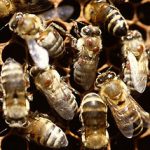
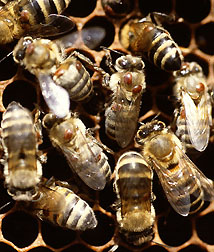
Brownish-orange bumps on the backs of these bees are Varroa jacobsoni mites.
Photo by Lila De Guzman. Image Number K5069-21
Frank A. Eischen, an entomologist with USDA’s Agricultural Research Service in Weslaco, Texas, has found that smoke from certain plants either kills varroa mites or causes them to fall off the bees.
This mite began infesting honey bee colonies in the United States in the 1980s, was discovered in 1987, and has since become the biggest threat to managed honey bees. The mites attach to bees and feed on their blood. If the infestation is severe and left untreated, the mites usually kill the colony.
The standard treatment for the mites is fluvalinate, a synthetic pyrethroid harmless to the bees. Beekeepers put fluvalinate-impregnated strips in their hives to kill mites, but they can use the strips only during times when bees are not making honey. Otherwise, the chemical could contaminate it.
Another problem with fluvalinate is that European researchers have reported that mites are developing resistance to the chemical.
Several years ago, Eischen began looking for alternative controls for mites. So far, he has tested smoke from about 40 plants. The first one he tried was a desert shrub called creosote bush, native to Mexico, Texas, and other areas of the Southwest. A Mexican beekeeper, David Cardoso, had recommended that Eischen test the olive-green plant, known in Mexico as gobernadora.
Eischen set up a standard lab test, placing 300 to 400 mite-infested bees inside a cage and covering the cage with a plastic container. Then he put the plant material inside his smoker, lit it, puffed the smoke into the container, and corked the plastic container opening to prevent the smoke from escaping.
He kept the smoke inside for 60 seconds, then removed the bees. Next, he placed the bees over a white, sticky card to catch any mites that fell off the bees.
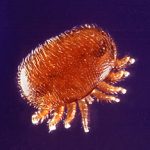
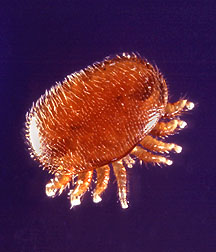
Varroa jacobsoni mite. Photo by Scott Bauer. Image Number K5111-10
“Lo and behold, the smoke from creosote bush was knocking down mites right, left, and center,” Eischen says. “It gave us the idea to start looking at other plants that, when burned, give off chemicals that removed the mites without harming bees.”
Among the 40 different plants Eischen has tested, the most promising plants are creosote bush and dried grapefruit leaves. Creosote bush smoke achieves a 90 to 100 percent mite knockdown after 1 minute, but Eischen says that excessive exposure can harm the bees. “It’s similar to burning tobacco in that respect,” he says. “It’s hard to find chemicals that remove mites without harming bees.”
Grapefruit leaves fit that description. After 30 seconds, smoke from the grapefruit leaves knocked down 90 to 95 percent of the mites in the cage test. With grapefruit leaves, however, few of the mites are killed. Most simply fall off the bees.
“The smoke chemicals either irritate the mites or confuse them. We aren’t exactly sure,” Eischen says. “But we do know that the grapefruit leaf smoke doesn’t seem to have any bad effects on the bees at all. The bees come through fine.”
Eischen stresses that the findings thus far are preliminary. “These are crude experiments, and we haven’t yet analyzed the active chemicals in the smoke that knock down the mites,” he says.
“We’re not yet telling beekeepers to use these methods for controlling varroa mites,” says Eischen. “We’re using these experiments to try to identify and isolate the chemicals that act as miticides.” — By Sean Adams, ARS.
Dr. Frank A. Eischen is at the USDA-ARS Honey Bee Research Laboratory, 2413 E. Hwy. 83, Weslaco, TX 78596; phone (956) 969-5007.